Temu Payment Methods: Which Cards and Wallets Actually Work
By Stash by TipidNation · October 6, 2026 · 5 min read
Short answer: a card or a digital wallet both get you through checkout, but they don’t behave identically once the charge actually goes through. A debit card is the one most likely to trip a bank’s own fraud check on an international-looking purchase; a credit card or mobile wallet tends to clear with less friction. None of this changes what you pay, only how smoothly you get there.
Cards and Wallets Aren’t Interchangeable at the Bank Level
Temu’s checkout treats a credit card, a debit card, and a digital wallet as equally valid ways to settle a cart. Your bank doesn’t always see it the same way. A debit card pulls directly from a checking account, so issuers tend to apply tighter real-time fraud screening to it than they do to a credit line, and a first-time charge from an overseas-billing merchant is exactly the kind of transaction that screening is built to catch. A credit card absorbs that risk differently, and a digital wallet removes the raw card number from the transaction entirely, which is part of why wallets clear more consistently.
Why Apple Pay and Google Pay Clear More Often
The advantage digital wallets have isn’t a better price, it’s tokenization. Instead of sending your actual card number to the merchant, Apple Pay and Google Pay generate a one-time device token for each transaction, so the charge looks, from the bank’s side, less like an unfamiliar merchant pulling raw card data and more like a routine authorized payment. That’s a security mechanic, not a discount mechanic. The coupon code and bundle structure behind any given cart applies exactly the same whether you tap to pay or type in sixteen digits.
Account Credit Is a Different Category Entirely
Cards and wallets settle a charge at the moment of checkout. Account credit doesn’t, it’s a balance already sitting on your account, usually from a referral reward or a return processed as store credit rather than cash, and it applies automatically before any card gets touched at all. The two mechanics shouldn’t be confused: a payment method is how the remaining balance gets charged, while bundle credit works more like a stored balance than a coupon code, applying first and reducing what any card or wallet needs to cover.
A Card-Branded Promo Page Isn’t a Different Checkout Rule
Temu runs separate promo pages for Mastercard and Visa, and it’s a fair assumption that one of them might unlock better checkout terms for that specific brand. It doesn’t, the Mastercard and Visa promos point to the exact same bundle, just split by which card brand a shopper is likely to search for. Picking either page has no effect on which payment methods actually work at checkout or how reliably they clear.
What to Do When a Method Gets Declined
A decline at checkout almost always traces back to the issuer, not to Temu rejecting the method outright. The usual fixes, in order of how often they actually work: confirm with your bank that international or first-time-merchant charges aren’t being auto-blocked, retry the same card a few minutes later once any temporary hold clears, or switch to a digital wallet if one is linked to the same funding source. Rotating between several different cards rarely helps and can trigger more scrutiny, not less.
Which Method to Pick If You Just Want It to Work
If checkout speed and fewer declines matter more to you than anything else, a digital wallet is the safer default where Temu supports one in your market. A credit card is the reasonable second choice. A debit card still works for most shoppers most of the time, it’s just the one most likely to need a second attempt. None of this changes the live bundle offer on the United States page or any other market, the payment method is a checkout detail, not a pricing one.
Questions Worth Answering
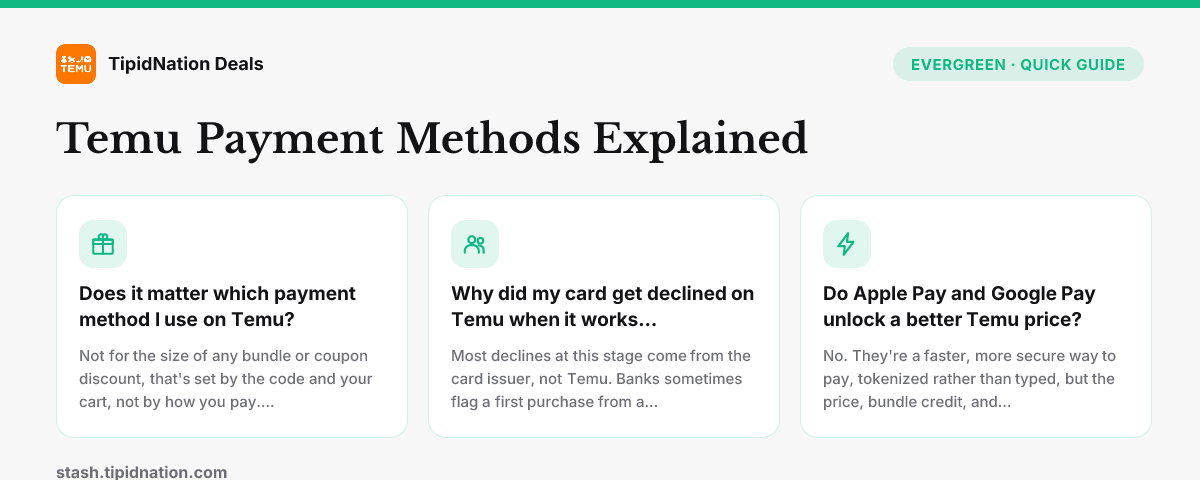
Not for the size of any bundle or coupon discount, that's set by the code and your cart, not by how you pay. It can matter for checkout reliability, since a debit card is more likely to get flagged by your bank for an international-looking charge than a major credit card or a mobile wallet.
Most declines at this stage come from the card issuer, not Temu. Banks sometimes flag a first purchase from a merchant they haven't seen before, especially one that bills internationally, as a precaution. Retrying after confirming the card with your bank, or switching to a digital wallet, usually clears it.
No. They're a faster, more secure way to pay, tokenized rather than typed, but the price, bundle credit, and any coupon code apply identically regardless of which supported method you choose at checkout.
None of this changes what’s currently live on the regular country pages, the current bundle offer is still active on the United States page and every other market Stash covers. For the full redemption walkthrough, see how Temu coupon codes work, and broader questions beyond this one are covered in the Temu Coupon Code FAQ.