Temu Marketplace vs Warehouse Listings: What the Difference Means for Shipping
By Stash by TipidNation · August 30, 2026 · 5 min read
Short answer: Marketplace listings ship from a seller’s overseas inventory, so delivery follows Temu’s standard international handling and transit timeline. Local Warehouse listings ship from stock Temu already holds closer to you, which usually means a shorter, more predictable window. Same storefront, two different fulfillment paths, and the label matters more than shoppers usually notice.
Two Listings, Two Supply Chains
Temu operates as a marketplace, meaning most products are listed by individual sellers who hold their own inventory, typically overseas, and ship each order out from there once it’s placed. That’s the default experience most shoppers picture. But a growing share of listings are fulfilled differently: Temu pre-positions inventory in local or regional warehouses, so the order ships from stock that’s already closer to the buyer rather than crossing a border after the fact. Both appear in the same search results, often for near-identical products, which is exactly why the distinction is easy to miss.
Why Shipping Timelines Split So Sharply
Handling time and transit time are the two numbers that make up any Temu delivery estimate, and fulfillment model is a big part of why those numbers vary so much listing to listing. A Marketplace order still has to clear the seller’s handling window and then travel internationally, customs included, before it reaches transit’s tail end. A Local Warehouse order skips most of that: the item’s already past customs and sitting in regional stock, so what’s left is closer to a standard domestic shipment. Two listings with an identical price tag can carry delivery estimates a week or more apart for this reason alone.
Where to Actually See the Label
The distinction isn’t always front and center. Look near the delivery estimate on the product page itself, that’s where a “Local Warehouse” note or similar shipped-from language tends to show up, rather than in the title or main image. If no label is visible, a delivery window that reads closer to a week is a reasonable signal you’re looking at warehouse stock, while an estimate stretching toward the higher end typically points back to a standard Marketplace listing shipping from overseas.
Does It Change What You Pay
Not as a rule, but not never either. A Local Warehouse listing can carry a small price premium over a Marketplace version of a similar item, since faster, closer fulfillment costs Temu more to maintain than a seller’s own overseas stock. It’s not the kind of gap that shows up on every product, and it has nothing to do with whether a reference price has been reset before a markdown, that’s a separate pattern entirely. If two listings for the same item differ noticeably in price, checking which fulfillment model each one uses is a reasonable first place to look for why.
Does It Change Returns or the Coupon Code
Return terms are set per listing regardless of fulfillment model, so it’s still worth checking the specific return window on the product page rather than assuming Marketplace and Local Warehouse follow identical policies. The coupon code, on the other hand, doesn’t care which one you’re buying. It applies at checkout based on your cart meeting the code’s conditions, not on where the item physically ships from, so there’s no reason to favor one listing type over the other just to make a code work.
Which One Should You Actually Pick
If the two listings are close in price, Local Warehouse is usually the safer bet when timing matters, a gift, a specific date, anything where a few extra days would be a problem. If price is the deciding factor and there’s no deadline pressure, a Marketplace listing shipping from overseas is often functionally the same product for less. Neither one is inherently the better deal, they’re just optimized for different things, and reading the label before checkout is what lets you actually choose rather than finding out which one you got after the estimate updates.
Questions Worth Answering
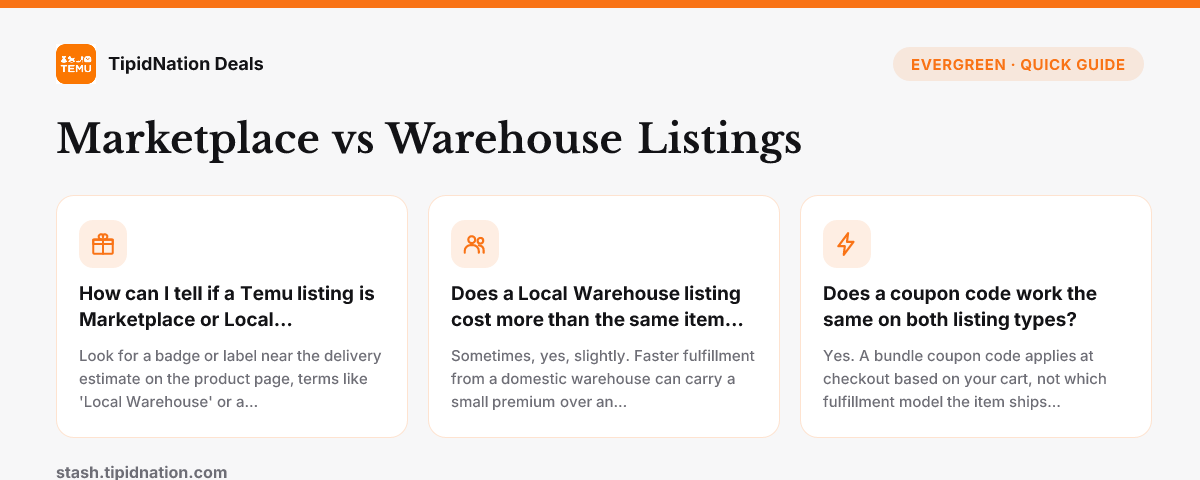
Look for a badge or label near the delivery estimate on the product page, terms like "Local Warehouse" or a shipped-from note. If the estimate reads closer to a week than several weeks, that's usually a warehouse-fulfilled listing even without an explicit label.
Sometimes, yes, slightly. Faster fulfillment from a domestic warehouse can carry a small premium over an identical item shipped directly from an overseas seller. It's not universal, but it's common enough to check both listings before assuming the cheaper one is the same deal.
Yes. A bundle coupon code applies at checkout based on your cart, not which fulfillment model the item ships under. Marketplace and Local Warehouse listings both qualify the same way, the code doesn't distinguish between them.
None of this changes what’s on offer right now, it’s just what to check before assuming two listings are interchangeable. The current bundle coupon is still live on the United States country page and every other market Stash covers. For the full redemption walkthrough, see how Temu coupon codes work, and broader questions beyond fulfillment are covered in the Temu Coupon Code FAQ.