Temu vs Falabella and Mercado Libre: Which Actually Wins in Peru
By Stash by TipidNation · October 14, 2026 · 7 min read
Falabella didn’t arrive in Peru as a stranger testing the market, it bought the country’s first modern department store chain outright. That history, plus Mercado Libre’s own delivery network, shapes how this comparison against Temu’s bundle coupon actually plays out for Peruvian shoppers.
Sears, Saga, Falabella: One Store, Three Names
The building block of Falabella’s Peru business didn’t start as Falabella at all. Sears opened its first Peruvian store in 1955, after Sears de Peru entered the market a few years earlier, and in 1988 that business was renamed Saga. Falabella, the Chilean retail group, bought a controlling stake in 1995, and the chain traded for over two decades as Saga Falabella before formally adopting the Falabella name in 2018. Today it runs dozens of department stores alongside sister chains Sodimac and Tottus, the same trio that backs Falabella in Chile and Colombia. Mercado Libre took a different route into the country, building a marketplace of local sellers on top of Mercado Envios, its own delivery arm, rather than opening a single store. Temu doesn’t try to compete on either front; it runs one bundle coupon that pays a flat credit once a cart clears a threshold, the mechanic behind how Temu coupon codes work — currently S/400 on the Peru storefront, a number set independently of what the bundle pays out in other countries.
The $200 Line SUNAT Wants to Move
Peru currently waives import duty and the 18% IGV on parcels valued at US$200 or less (product value, not including freight), under the country’s simplified courier import regime. Cross that line and a shipment between US$200.01 and US$2,000 typically owes 4% ad valorem plus 18% IGV, calculated on the combined cost of the goods, freight, and insurance. SUNAT’s own leadership has floated applying IGV to sub-$200 orders too, aimed squarely at the volume of parcels coming from platforms like Temu, Shein, and AliExpress, but that change needs Congress to amend the General Customs Law first and hadn’t taken effect at the time of writing. Falabella and Mercado Libre’s domestic sellers skip this question entirely, since a sale completed inside Peru already carries IGV as a normal part of the price.
Lima in Two Days, the Rest of the World in Weeks
Mercado Libre has pushed hard on local logistics, reporting that roughly 30% of Mercado Envios deliveries arrive within 24 hours and about 80% within 48 hours, and it now advertises free nationwide shipping on orders above S/39. Falabella ships from its own Peruvian warehouses and store network, usually landing within a comparable few-day window, and its physical stores mean pickup or an in-person look at an item is on the table in a way Mercado Libre can’t offer. Temu’s fulfillment runs almost entirely overseas, so transit commonly stretches one to three weeks once customs clearance is added in, covered in more depth in Temu shipping times, explained. Anyone shopping against a deadline in Lima or another major Peruvian city is better served by either local option than by waiting on a Temu parcel.
Seven Business Days, and What Happens After
The Codigo de Proteccion y Defensa del Consumidor (Ley 29571) gives Peruvian shoppers a derecho de retracto on distance purchases: generally understood as 7 business days to cancel without stating a reason, as long as the product hasn’t been used, with INDECOPI as the enforcement body and its Reclama Virtual platform as the escalation path when a seller won’t cooperate. That right applies to any business selling to a Peruvian consumer, which legally covers Temu exactly as it covers Falabella and Mercado Libre’s marketplace sellers. Where the three diverge is what happens once that window is exercised: a Falabella return can go straight to a physical counter, a Mercado Libre return typically moves through a domestic pickup tied to its own logistics network, and a Temu return has to travel back overseas, stretching out a process that’s generously timed on paper, laid out in Temu return policy, explained, but inherently slower in practice. None of that touches whether Temu is legitimate to begin with; it’s a distance-and-logistics question, not a trust one.
Who Each Platform Actually Suits
Someone who wants to inspect an item in person, return it at a counter, or buy something urgently needed this week has the strongest case for Falabella or Mercado Libre, and Mercado Libre’s free-shipping threshold makes smaller, frequent orders cheap to place. Someone assembling a larger, unhurried basket, home goods, electronics, seasonal items, where the flat bundle credit has room to apply and a few weeks of transit changes nothing, is where Temu’s math tends to come out ahead. Calling any one of the three the default winner skips the part of the comparison that actually matters: what’s in the cart and how soon it’s needed.
Checking the Numbers Before You Commit
Peru’s sub-$200 import exemption is the detail most worth rechecking before assuming a Temu order will clear customs tax-free, since SUNAT has already said publicly it wants that threshold gone. Confirm the current bundle terms on the Peru page before comparing it against whatever Falabella or Mercado Libre is running that week, and for how a similar Falabella-and-marketplace matchup plays out one country over, see Temu vs Mercado Libre and Falabella in Colombia. The rest of this series, covering every market Temu runs a bundle coupon in, is on the sitemap.
Questions Worth Answering
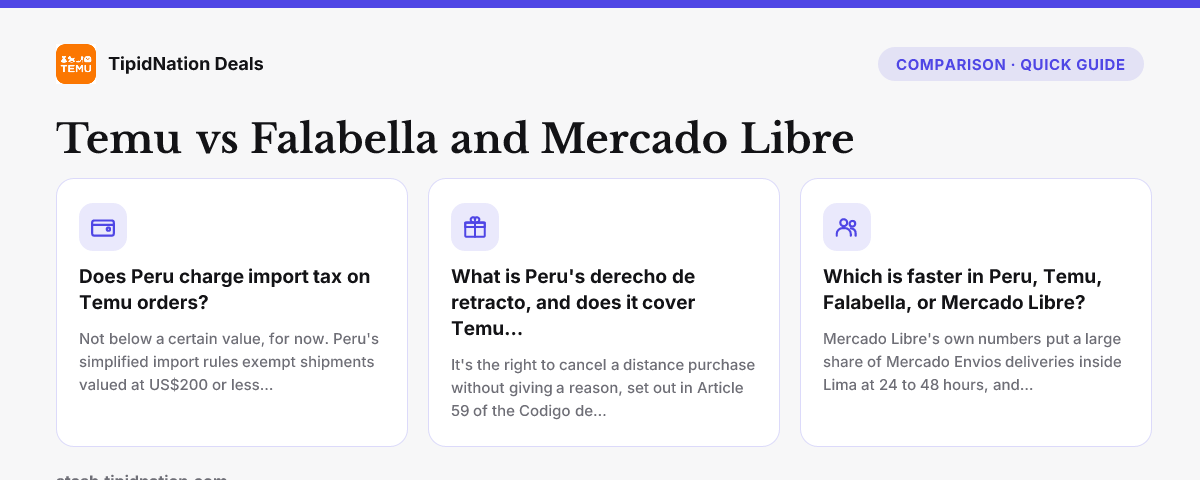
Not below a certain value, for now. Peru's simplified import rules exempt shipments valued at US$200 or less (FOB, product value only) from ad valorem duty and the 18% IGV. Above that, orders between US$200.01 and US$2,000 typically pay 4% ad valorem plus 18% IGV on the CIF value. SUNAT has publicly floated applying IGV to sub-$200 parcels too, but as of this writing that change requires amending Peru's General Customs Law in Congress and hasn't taken effect, so check the current rule before assuming either way.
It's the right to cancel a distance purchase without giving a reason, set out in Article 59 of the Codigo de Proteccion y Defensa del Consumidor (Ley 29571) and enforced by INDECOPI, generally understood as a 7-business-day window from receiving the product. It applies to any seller doing business with a Peruvian consumer, foreign or domestic, which covers Temu the same as it covers Falabella and Mercado Libre's marketplace sellers. A complaint that goes nowhere with the seller can be escalated through INDECOPI's Reclama Virtual platform.
Mercado Libre's own numbers put a large share of Mercado Envios deliveries inside Lima at 24 to 48 hours, and the platform advertises free shipping nationwide above S/39. Falabella ships from its own Peruvian distribution network and stores, usually landing within a similar few-day window, with in-store pickup as an option Mercado Libre can't match. Temu ships from overseas, so transit plus customs clearance commonly runs one to three weeks.
Check the current bundle offer on the Peru page, or read Temu return policy, explained for more on how that process plays out once an order ships. Comparing a different market in this series? Browse the full list on the sitemap.