Temu Seller Ratings: How to Read Them Before You Buy
By Stash by TipidNation · August 31, 2026 · 5 min read
Short answer: the star average is the least useful number on the page by itself. Review count and the rating’s breakdown, how many of those reviews are recent and how many mention the specific item versus the seller generally, tell you far more about whether a rating is trustworthy than the headline decimal does.
The Star Average Alone Doesn’t Tell You Much
A 4.7 next to a listing looks like a clean signal, but it’s really a summary hiding the one number that determines whether it means anything: how many reviews built it. Ten reviews averaging 4.7 and ten thousand averaging 4.7 display identically on the product page, and they are not remotely the same claim. The larger sample has absorbed enough different buyers, different expectations, different shipping outcomes, to actually reflect what most orders look like. The smaller one could just as easily be a handful of enthusiastic early buyers or a seller’s own network. Check the count before trusting the average, it’s the number that turns a rating from an impression into evidence.
Why Review Count Matters More Than the Decimal
Once a seller has a few hundred reviews or more, the average tends to stabilize and stop swinging much with each new order. Below that, a single bad batch or one especially happy buyer can move the number noticeably. That’s not a reason to write off every low-review-count listing, new listings and newer sellers start somewhere, but it is a reason to treat a thin sample as provisional rather than settled. A 4.5 with thousands of reviews behind it is a more dependable bet than a 5.0 with a dozen.
Read the Breakdown, Not Just the Average
Most Temu listings let you filter reviews by star count, and that filter is worth using before checkout, not after a problem shows up. Skim the 1- and 2-star reviews specifically, they’re where a real pattern surfaces, sizing consistently off, a color that doesn’t match photos, packaging issues on a specific variant. A handful of scattered low reviews across unrelated complaints is normal for any seller at scale. The same complaint repeating across multiple reviewers is the pattern that actually predicts your own experience.
Item Reviews vs. Seller Reviews Aren’t the Same Thing
Ratings on Temu attach to both individual listings and to the seller as a whole, and it’s easy to conflate the two. A seller with a strong overall reputation can still have one specific listing with a mediocre track record, mismatched expectations on that particular item, a size chart that runs small, photos that flatter it more than reality does. Whenever a product page shows both a seller score and an item-level rating, the item-level number is the more relevant one for the specific purchase in front of you, the seller score is better read as context, not a substitute.
Does Any of This Affect the Coupon or Return Terms
No on both counts. Return policy is set per listing, not per seller rating, so a lower-rated item doesn’t come with weaker return protection, and a five-star seller doesn’t get you a better return window either. The bundle coupon code works the same way: it applies at checkout based on your cart, with no connection to which seller or rating tier the item falls under. Rating is a signal for the purchase decision itself, it doesn’t change what happens after you buy.
A Quick Way to Check Before You Buy
Before adding anything from an unfamiliar seller, a thirty-second habit covers most of what matters: check the review count clears a few hundred, skim the lowest-starred reviews for a repeating complaint, and confirm the rating you’re looking at belongs to the specific item rather than just the storefront. That’s roughly the same discipline that goes into treating the platform itself as legitimate rather than assuming risk by default, Temu earns that trust the same way any individual seller does, on the evidence rather than the badge.
Questions Worth Answering
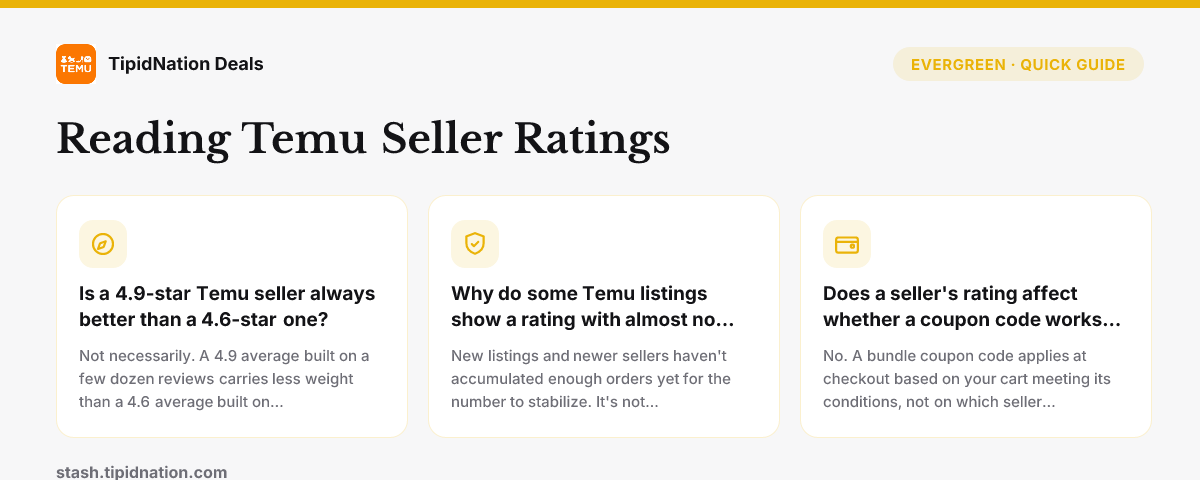
Not necessarily. A 4.9 average built on a few dozen reviews carries less weight than a 4.6 average built on several thousand. Review count is what turns a star average into a reliable signal, not the decimal itself.
New listings and newer sellers haven't accumulated enough orders yet for the number to stabilize. It's not automatically a red flag, but it does mean the rating is a smaller sample than it looks, worth treating as provisional rather than proven.
No. A bundle coupon code applies at checkout based on your cart meeting its conditions, not on which seller or rating tier the item comes from. Rating and coupon eligibility are unrelated systems.
None of this changes what’s on offer right now, the current bundle coupon is still live on the United States country page and every other market Stash covers. For the full redemption walkthrough, see how Temu coupon codes work, and broader questions beyond seller ratings are covered in the Temu Coupon Code FAQ.