Temu vs Zap and Amazon: Which Actually Wins in Israel
By Stash by TipidNation · October 10, 2026 · 7 min read
Zap isn’t a seller, and Amazon has never opened a dedicated Israeli storefront, so this isn’t really “three stores fighting over your cart” the way the comparison plays out in most other markets. Here’s how Temu’s single bundle coupon actually stacks up against a price-comparison giant and a cross-border catalogue.
Zap Doesn’t Sell Anything Itself
Zap Group, based in Petah Tikva, runs the country’s largest price-comparison and yellow-pages web operation — Apax Partners bought it for NIS 150 million in 2015, and by 2025 Axel Springer was reportedly negotiating to buy it for NIS 400-450 million. Across roughly 22 sites, Zap lets shoppers compare more than 1.5 million products against listings from some 450,000 businesses, alongside professional and user reviews, then typically hands the actual purchase off to whichever retailer’s listing wins the comparison. That’s structurally different from the marketplaces elsewhere in this series: Zap carries no inventory, runs no warehouse, and operates no delivery fleet of its own. Temu runs on one mechanic across every market instead, a flat coupon paying out once a cart clears a threshold, explained in how Temu coupon codes work — currently ₪400 on the Israel storefront, a figure set independently of what other countries’ bundle values look like.
There’s Still No Amazon.co.il
Amazon has talked about a dedicated Israeli launch since at least 2018, floated a Hebrew-language vendor portal, and even built a “Ships Locally” filter that surfaces third-party sellers who keep stock inside the country — but there’s no amazon.co.il storefront, and no Amazon fulfillment center anywhere in Israel. Most Israeli shoppers buying from Amazon are still ordering directly off amazon.com, paying international shipping on top with no Prime-speed guarantee behind it. That’s a sharper gap than the Amazon-ships-in-from-a-neighboring-country pattern seen in places like Greece or New Zealand; here it’s genuinely cross-border from the US every time, with no regional storefront standing in between.
An Import Threshold the Knesset Changed Twice in One Year
Israel’s standard VAT rose from 17% to 18% on 1 January 2025, a deficit-driven hike tied to war-related government spending. On top of that, the personal-import exemption that decides when VAT even applies to an overseas order has been a moving target through 2026: the Knesset briefly raised the duty-free threshold to $130, then cancelled that increase and put it back down to $75. Anything shipped into Israel above that $75 line now faces 18% VAT, collected either at the border or increasingly at checkout the way AliExpress began doing for orders over $75 rather than letting the package sit at customs. That threshold applies the same way no matter which overseas platform ships the order; a Zap-linked purchase from an Israeli retailer skips it entirely, since the listed price already includes Israeli VAT.
Delivery Speed Comes Down to Who’s Actually Fulfilling the Order
Because Zap itself never ships anything, speed through Zap is really the speed of whichever retailer’s listing a shopper picks — some Israeli sellers move orders within a day or two through domestic couriers, others take longer, and Zap’s comparison tables don’t standardize that part of the listing. Amazon’s cross-border orders have historically taken weeks once customs and import processing are factored in, slower than most of the Amazon fallbacks covered elsewhere in this series since there’s no regional warehouse absorbing part of the trip. Temu ships from its own overseas hubs, typically one to two weeks, a range broken down fully in Temu shipping times, explained. Anyone who needs an item fast is better served hunting a Zap listing from a local seller than waiting on either cross-border option.
Two Very Different Return Paths
A purchase made through a Zap-linked Israeli retailer falls under ordinary domestic consumer protection — Israel’s Protection of Consumer Law gives buyers a cooling-off right to cancel a distance sale within 14 days of the purchase or of receiving the required transaction summary, whichever is later, and because the seller is local, resolving it doesn’t involve shipping anything out of the country. Amazon and Temu returns both have to travel back the way the order arrived. Temu’s stated window is commonly 90 days, laid out in Temu return policy, explained, but since that inventory is heading back overseas rather than to a domestic address, full resolution takes longer than anything routed through a Zap listing. None of that is a legitimacy question for either cross-border option — a separate point covered in is Temu legit — it’s just what distance costs in time.
Who Actually Comes Out Ahead
Someone who wants an item today, or already trusts a specific Israeli retailer’s listing, has the clearest answer in Zap — it was built for exactly that kind of comparison shopping, even though Zap itself never touches the order. Someone chasing a specific product that no Israeli seller stocks still has a reason to put up with Amazon’s cross-border wait, workaround filters included. A shopper assembling a bigger, unhurried basket — home goods, gadgets, seasonal items — where the flat bundle credit has room to apply and a week or two in transit changes nothing, is where Temu’s coupon math tends to pull ahead of either alternative. A related regional read: Temu vs Noon and Amazon in Saudi Arabia covers a market where the overseas competitor built local fulfillment instead of staying cross-border.
Questions Worth Answering
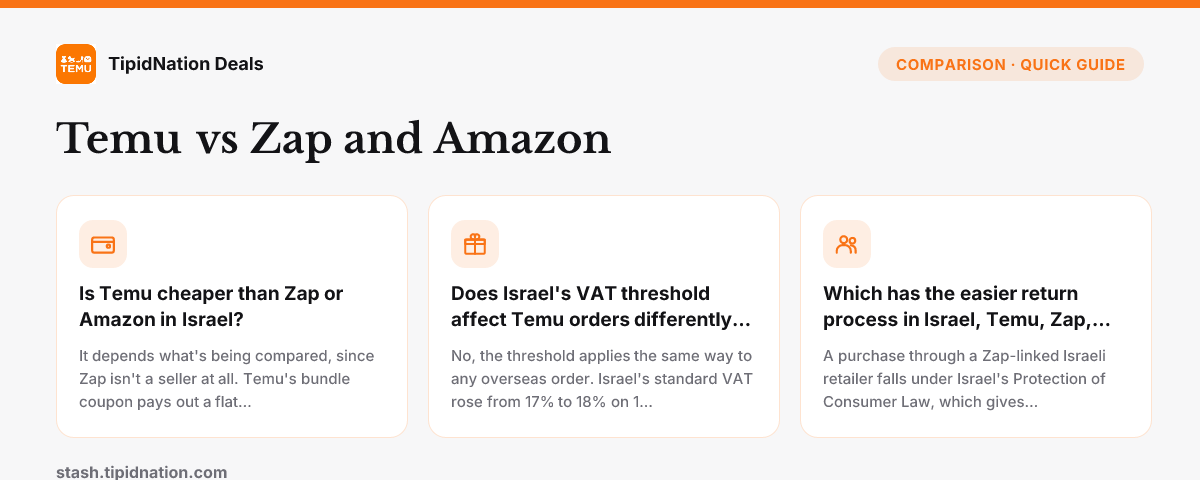
It depends what's being compared, since Zap isn't a seller at all. Temu's bundle coupon pays out a flat credit once a cart clears a threshold. Zap is a price-comparison engine that surfaces the best listing across roughly 450,000 Israeli businesses and then hands the sale off to whichever retailer wins, so its price is really that retailer's price. Amazon, shipped in cross-border with no local warehouse, competes on catalogue breadth rather than Israel-specific pricing. Temu tends to win on a larger, non-urgent haul; a Zap-surfaced local listing tends to win on a specific item wanted fast.
No, the threshold applies the same way to any overseas order. Israel's standard VAT rose from 17% to 18% on 1 January 2025. The Knesset briefly raised the personal-import exemption to $130 before cancelling that increase in mid-2026 and returning it to $75; packages valued above that line face 18% VAT collected at the border, or increasingly at checkout. That applies equally whether the order ships from Temu or from Amazon's international site. Purchases made through a Zap-linked Israeli retailer aren't affected, since the listed price already includes Israeli VAT.
A purchase through a Zap-linked Israeli retailer falls under Israel's Protection of Consumer Law, which gives buyers a 14-day cooling-off right to cancel a distance sale, and since the seller is local, nothing has to ship out of the country to resolve it. Amazon and Temu returns both travel back the way the order came. Temu's stated window is commonly 90 days, but full resolution takes longer than a domestic return since the inventory is heading back overseas.
The ₪400 threshold on the Israel page is worth checking against whatever Zap listing or Amazon cart is already open in another tab — it’s the one number here that actually moves. The full set of markets this series tracks is on the sitemap.