Temu vs Noon and Amazon: Which Actually Wins in Saudi Arabia
By Stash by TipidNation · September 2, 2026 · 6 min read
There’s no single winner between Temu, Noon, and Amazon in Saudi Arabia, and the comparison isn’t as simple as “who’s cheapest,” because all three are built on genuinely different models. What actually wins on price depends on the order itself: what’s in it, how soon you need it, and how much you trust the seller you’d buy it from.
Three Different Models, Two Established Regional Players
Noon isn’t just another competitor in Saudi Arabia, it’s one of the region’s default marketplaces, launched in 2016 with backing that includes Saudi Arabia’s own Public Investment Fund, and built on a mix of local sellers, its own warehousing, and a logistics arm that layers Noon Express fast-shipping on top of frequent seller campaigns and its annual Yellow Friday event. Amazon competes differently here: after acquiring the Dubai-based Souq.com in 2017 and rebranding it as Amazon.sa in 2020, it now runs local fulfillment centers inside Saudi Arabia rather than shipping every order across a border, with Prime membership sharpening delivery speed further on top of that. Temu runs on a different mechanic entirely: a single coupon crediting a set amount once the cart passes a threshold, covered in how Temu coupon codes work. That threshold and payout is calibrated per market, which is why the Saudi Arabia bundle value reads differently than what shoppers see in other countries, something we go deeper on in why Temu coupon values differ by country. In practice, Temu rewards building one larger, less urgent cart, Noon rewards shoppers who already know which seller they trust, and Amazon.sa rewards anyone who wants a familiar global catalogue backed by a local warehouse.
Shipping: Noon and Amazon.sa’s Local Fulfillment Is Real
This is where both regional players show up strongest. Because Noon Express and Amazon.sa’s fulfillment centers are both built for Saudi addresses specifically, orders routinely land in Riyadh and Jeddah same-day or next-day, and Prime membership tightens that further on eligible Amazon.sa listings. Temu leans on overseas fulfillment instead, so transit commonly runs one to two weeks, a window we break down fully in Temu shipping times, explained. Temu’s estimate tends to hold once it’s quoted, but “reliable and slow” still loses to next-day delivery, so anyone who needs an item this week should default to Noon or Amazon.sa rather than Temu.
Trust and Returns: Different Risk Profiles, Not Different Legitimacy
All three are legitimate, widely used ways to shop in Saudi Arabia, that’s not in question. What differs is how return logistics actually play out. Noon built its reputation on fast regional pickup for returns, most sellers accept a courier collection with little back-and-forth. Amazon.sa runs a similarly mature local return system now that it operates its own Saudi fulfillment centers, a meaningful upgrade from the cross-border Souq.com days. Temu’s return policy is competitive on paper, commonly a 90-day window, but since most inventory ships from outside the country, starting and completing a return typically takes longer than either local option’s process, something we lay out fully in Temu return policy, explained. That’s structural, not a legitimacy concern, and worth separating from whether Temu is legit as a platform.
Who Actually Wins, By Shopper Type
If you need something today, or you’re buying from a seller you already trust on a regional marketplace, Noon is the better default in Saudi Arabia, and it’s genuinely hard for either Temu or Amazon.sa to beat on speed and seller familiarity here. If you’re chasing a specific global brand or a wider catalogue backed by local delivery, Amazon.sa’s fulfillment centers make that a reasonable middle ground. If you’re building a larger cart of non-urgent items instead, home goods, gadgets, seasonal decor, where the bundle coupon has room to apply and a week or two of transit doesn’t matter, Temu’s model can beat what you’d pay chasing individual Noon or Amazon.sa campaigns. None of the three comes out ahead automatically, calling one always-better is the sales pitch, not the honest read. We cover a comparable two-strong-local-player dynamic in Temu vs Trendyol and Hepsiburada in Turkey, and a similar local-marketplace-versus-overseas tradeoff in Temu vs Amazon Mexico and Mercado Libre.
The Honest Middle Ground
Plenty of Saudi shoppers keep all three apps installed for exactly this reason: check Noon first for anything urgent or seller-specific, check Amazon.sa for global brands with local delivery, then check Temu for a bigger non-urgent haul where the bundle coupon applies. Temu’s advantage shows up clearest on larger, non-urgent carts with a predictable estimate; Noon’s advantage shows up on speed and seller trust; Amazon.sa’s advantage shows up on catalogue breadth backed by a local warehouse. Checking the Saudi Arabia page for the current bundle terms takes a minute, and it’s the only real way to know if Temu’s math beats whatever campaign you’d otherwise chase on Noon or Amazon.sa that day.
Questions Worth Answering
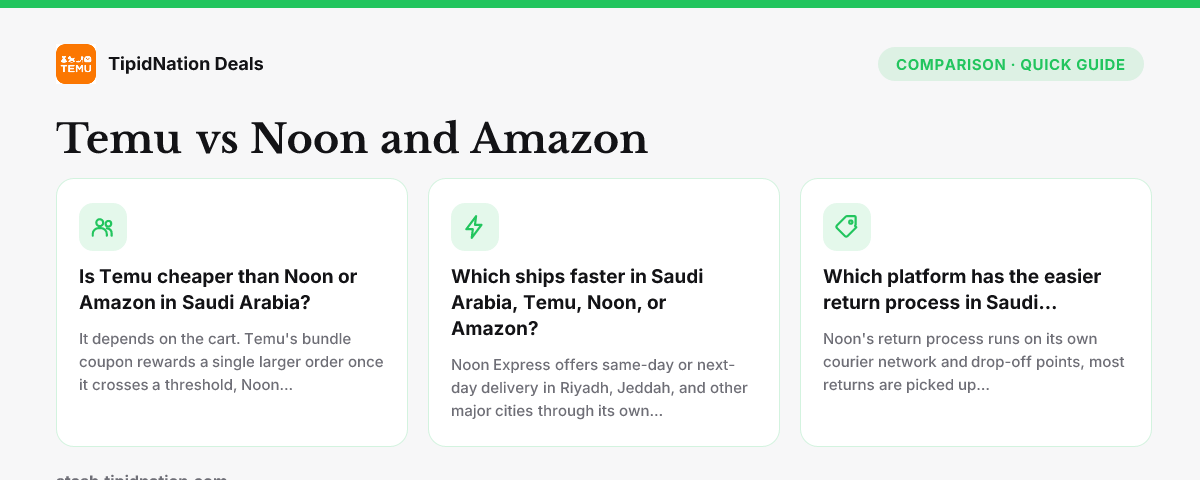
It depends on the cart. Temu's bundle coupon rewards a single larger order once it crosses a threshold, Noon runs constant seller-level flash campaigns plus its own Yellow Friday event, and Amazon.sa competes on catalogue breadth backed by local fulfillment centers. Temu tends to win on bigger, non-urgent hauls; Noon and Amazon tend to win on items needed fast or bought from a specific trusted seller.
Noon Express offers same-day or next-day delivery in Riyadh, Jeddah, and other major cities through its own regional logistics network. Amazon.sa also ships from local fulfillment centers inside the country, typically one to two days for eligible items, faster with Prime. Temu ships primarily from overseas, so transit typically runs one to two weeks, longer than either local option even though the estimate holds once quoted.
Noon's return process runs on its own courier network and drop-off points, most returns are picked up domestically with little friction. Amazon.sa offers a similarly mature local return system backed by its Saudi fulfillment centers, especially convenient for electronics and larger orders. Temu's return window is competitive on paper, commonly 90 days, but processing takes longer since inventory ships from outside the country.
Check the current bundle offer on the Saudi Arabia page, or see how Temu return policy, explained breaks down the return question in more detail. Comparing another market? The Turkey comparison covers a similar two-strong-local-player dynamic, or browse the full list on the sitemap.